
On Gifts That Devour
A Review & Meditation on Nolan's The Odyssey
Dear Reader,
I make no pretension of being an expert classicist, but after seeing Christopher Nolan’s The Odyssey earlier today, allow me a few thoughts on the film, as well as a meditation on what I took away from it.
I’m not going to worry about spoiling the overarching story—the world has had 2,800 years to read it—but I’ll try to be careful with any details unique to this version of Homer’s tale that might take away from your viewing experience.
As always, I welcome your own thoughts and reviews in the comments. Enjoy.
Craig
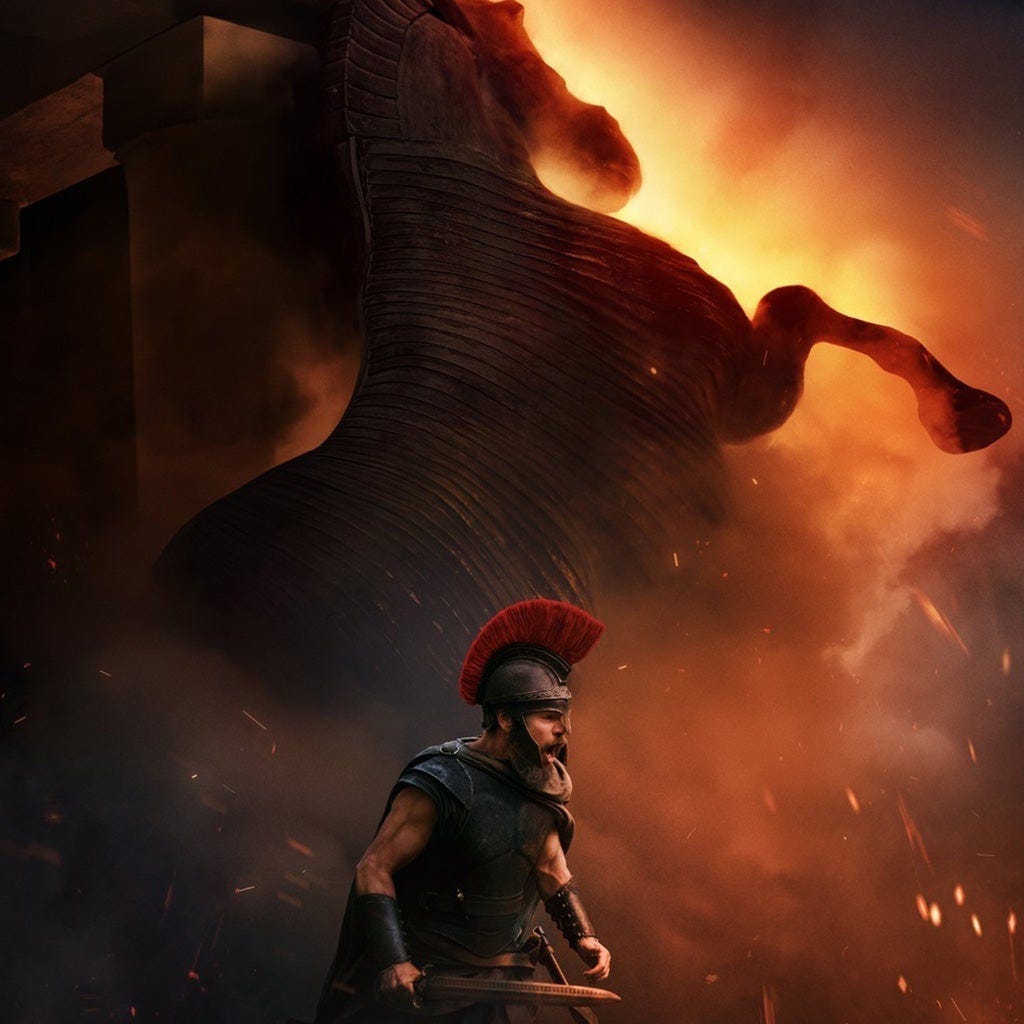
Christopher Nolan’s The Odyssey is a remarkable film. But what stayed with me afterward wasn’t any particular battle scene or performance. It was an ancient idea Homer builds his entire epic around—one that may explain a surprising amount about our own age.
Despite being the loudest movie I’ve ever heard in a theater (yes, we saw it in IMAX and my ears are still ringing), and even being 20-30 minutes too long at nearly three hours run time (not including the 25 minutes of previews studios stacked on the front end for eager eyeballs), The Odyssey is “epic” in every sense of the word—script, direction, soundtrack, effects, acting. A few observations:
Script
When this trailer for the movie dropped back in early May, I was concerned for reasons first and foremost having to do with the writing, remarking on Facebook:
“As epic as the shots are in this latest trailer for Christopher Nolan’s take on The Odyssey…Tom Holland’s Telemachus calling Odysseus ‘my dad’ is the worst anachronistic line I’ve heard in a long time.”
A month later, in this June Second Drafts post listing Homer’s work as a book I was reading, I wrote:
“Not pursuing Emily Wilson’s 2017 version, which is what Nolan based his film on; early trailers with ‘dad’ and ‘let’s go’ haven’t changed my mind, nor has the swirl of feminist perspectives praising its political correctness.)”
Despite more than a few more “dad” lines (and one “mom” line, which bent my ear more), Nolan’s choice to utilize modern speech was ultimately a non-issue (though I could have done without the two F-bombs thrown in for no real reason). The dialogue between characters is honest and moves the story along clearly, and any feminist influence/re-imagining from Wilson seemed non-existent.
We forget sometimes how much of Nolan’s writing talent supports his ability as a director; one of his advantages is he gives himself good material to work with.
Direction
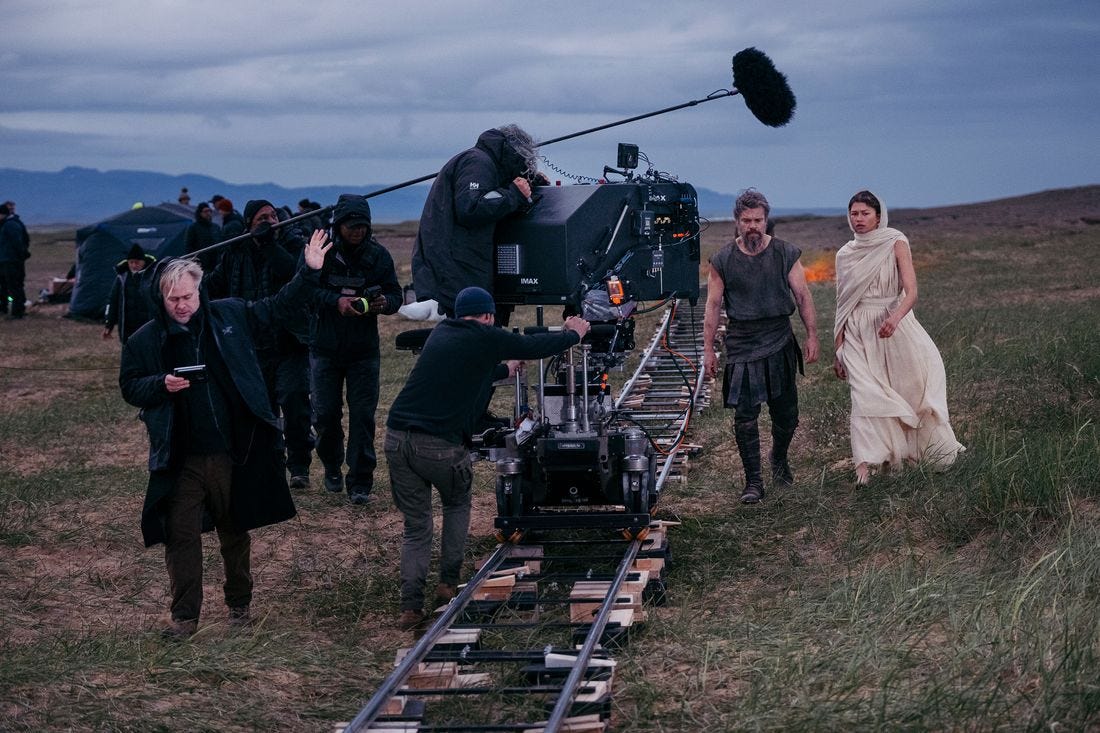
Visually, the film is a masterclass of composition—to set the scene, to follow the action, to create more character connection than one might think possible in a movie of this scale. But as the 21st century’s cinematic heir apparent, Nolan brilliantly leads the eye where to look, creating ample room for characters and their plights in beautiful balance with the backdrops.
Soundtrack
While I’m partial to more melodic works created by composer Hans Zimmer for Nolan’s earlier films (The Dark Knight trilogy in general; Interstellar in particular), The Odyssey’s more ethereal/percussive score by three-time Academy Award-winning composer Ludwig Göransson serves as a compelling soundtrack. Though often way too loud, the gongs and bangs of the Bronze Age are well-represented.
Effects
Not one to rely on (or use much of any) green screen special effects, Nolan’s world of The Odyssey has an authentic ruggedness to its scenery that provides stunning backdrops for well-choreographed battles—both physical and verbal alike.
Likewise, scenes involving monsters like the Cyclops Polyphemus and Scylla, the six-headed creature who plucked men from the boat opposite the whirlpool Charybdis, seemed much more real than CGI might render them. Finally, Circe’s practical handiwork in turning Odysseus’ men into pigs (and back again) was at least as believable as it was disturbing.
Acting
In the months and weeks leading up to the release of The Odyssey, Nolan took a fair amount of grief for his casting decisions. I only voiced one critique online after watching the aforementioned May trailer:
“Robert Pattinson as Antinous is not doing it for me…I’m a Nolan fan and will definitely see this one in the theater, but his casting has become increasingly insular with each film.”
Having seen the film, I’m happy to report that Pattinson (somewhat) redeems himself, becoming the worst of the plotting suitors. I also found the ensemble (artistically or racially) neither wanting nor “woke,” the latter of which was (and still seems to be) the cry of too many folks getting their tunics in a twist.
While initially ambivalent about Matt Damon in the lead role, he made far more than just an adequate Odysseus, particularly as he wrestled with consequences of his character’s famed cleverness. Some are calling for Anne Hathaway to win an Oscar already for her role as Penelope, but I thought her performance simply accomplished and nothing more, as I also thought of Charlize Theron’s Calypso.
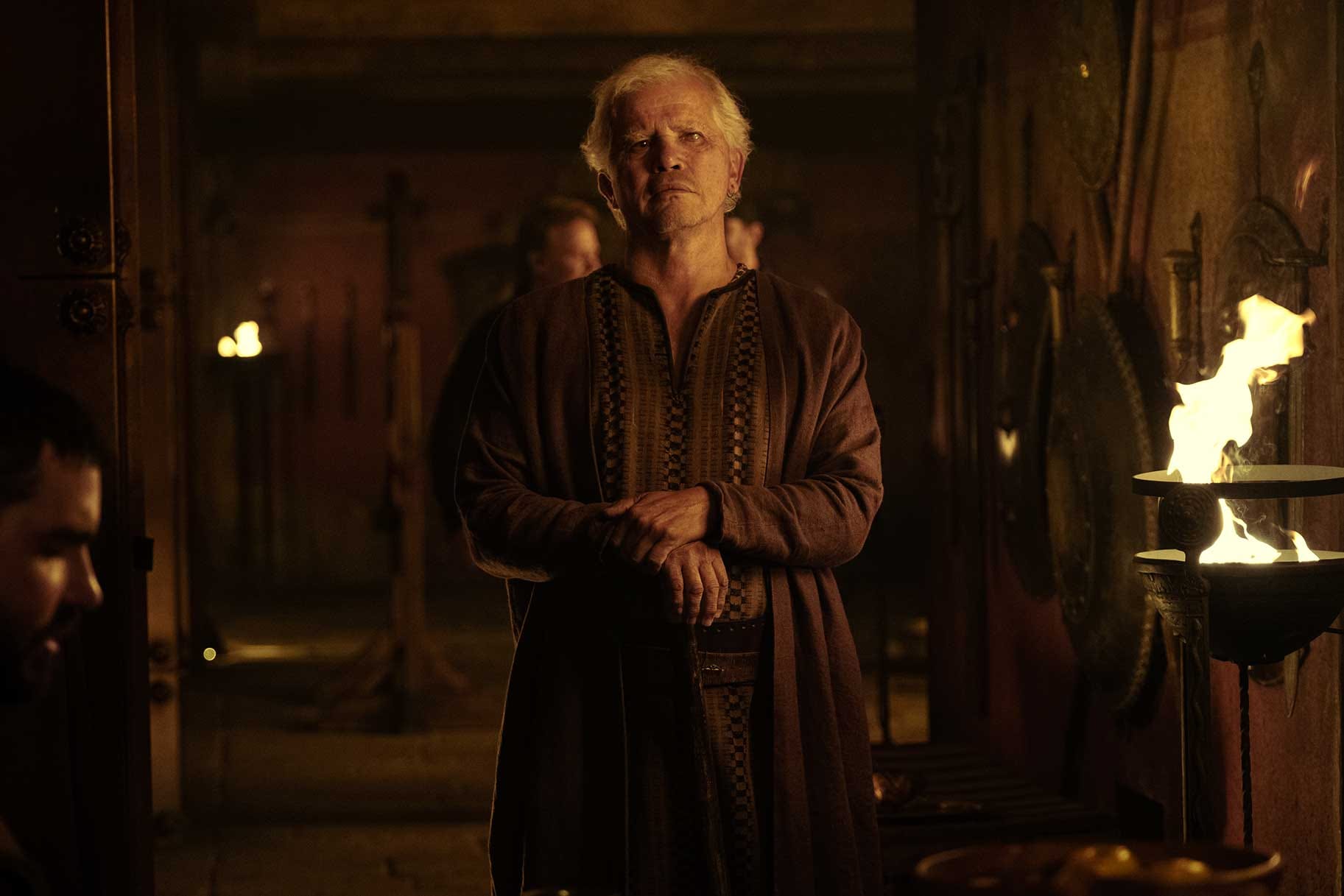
Tom Holland as Odysseus’ son, Telemachus, was the best I’ve seen him in a non-Spider-Man role, a fact not lost on me as I’m not a fan (really at all) of his manic webslinger persona. The lesser-known (at least to me) Samantha Morton’s performance as the witch goddess Circe was noteworthy, and I enjoyed John Leguizamo as Eumaeus, Odysseus’ loyal, blind swineherd and trusted friend.
Zendaya as the goddess Athena played pretty flat in her limited screen time, and while Lupita Nyong’o as Helen of Troy did more with her even fewer minutes, people who freaked out about her being cast in the role should feel pretty silly considering her small part. (The same could be said for Elliot Page’s role not as Achilles but as Sinon, a young Greek soldier with a heartbreaking backstory.)
My Takeaway
All in all (and as you can probably tell), the experience of watching The Odyssey was a powerful one. Despite being at 10 a.m. on a Saturday morning, it was a pretty full house, and I only had to ask two different people to put their phones away during the three-hour film (don’t worry: I was kind).
Yes, the hype leading up to the movie has been insane, but the film lives up to the hype, and perhaps even exceeds it. Yes, the volume (particularly—but not only—during the fight scenes) is way too loud (and no, that’s not me just being a crusty old guy; the GenZ couple we went with thought it was awfully loud as well). And yes, the merchandising of the Trojan Horse popcorn bucket is ridiculous.

But one of the themes that came together for me from Nolan’s film is the connection between said Trojan Horse, Penelope’s suitors, and Zeus’ Law. The classical concept underneath all three is xenia: the sacred law of hospitality between host and guest, which Zeus himself was said to guard.
The Horse is a gift that violates it—pretending to make peace with the purpose of exploiting Troy. The suitors are guests who violate it—leading with gifts for the purpose of devouring Penelope’s household and courting her. Polyphemus violates it from the host’s side, devouring guests instead of feeding them. So, too, does Calypso, manipulating Odysseus to stay with her for seven years. The key to understanding The Odyssey has to do with what happens when the giving-and-receiving relationship becomes weaponized.
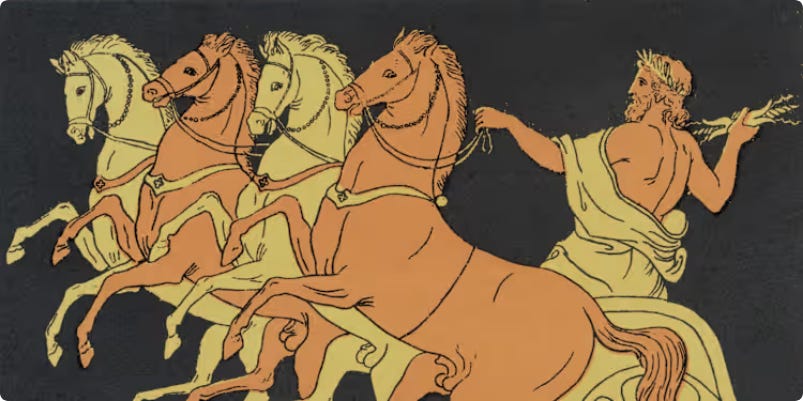
Zeus' Law treated hospitality as sacred because the gift was the currency of trust between strangers; to violate that trust was to undermine the fabric of civilization itself. After all, one might entertain gods without knowing it, so why take the chance of offending them, especially if they offer something in advance?
But a deceptive gift is worse than open hostility because it corrupts this very mechanism of trust. The Odyssey illustrates this: an enemy at the gate is honest, whereas a horse at the gate is not; suitors are more dangerous than an invading army precisely because they came (and remain) as guests.
Gifts given with deceptive intent rarely end up good gifts in the end.
Consider our present moment: How much of what’s offered to us now (politically, commercially, digitally) comes packaged as a gift with the intent concealed? The freedom to vote on a particular issue rarely stops with that particular issue when both parties pork up a bill. The promotional offering of financial credit comes with major percentages of interest if just one payment is missed. The free apps that promise convenience and ease then monetize our information and attention.
The more beneficial countermeasure to the Trojan Horse and the gifts of the suitors (or any of our other modern variations) is the gift given with nothing concealed. James 1:17 says that every good and perfect gift comes from the Father, “with whom there is no variation or shadow due to change.”
Christianity doesn’t abolish hospitality; it grounds it. The God who owes us nothing becomes the Host who welcomes strangers—not because He has been appeased, but because He delights to give. The gospel’s scandal isn’t that God gives, but that there’s no catch.
This is exactly why suspicious people (trained by a lifetime of deceptive gifts) struggle to receive it; they inspect mercy for hidden soldiers and regard grace as suspect assuming plans to devour.
The gods of Homer are essentially little more than powerful humans—capricious, petty, seducible, playing favorites, using mortals as pieces in their rivalries. Athena helps Odysseus because she likes him. Poseidon torments him out of spite. Zeus guards hospitality, but even his justice is reactive and unpredictable. The ancients could hope in the favor of particular gods, but they could never rest in the character of any god; often, the best they could do was try to manage them.
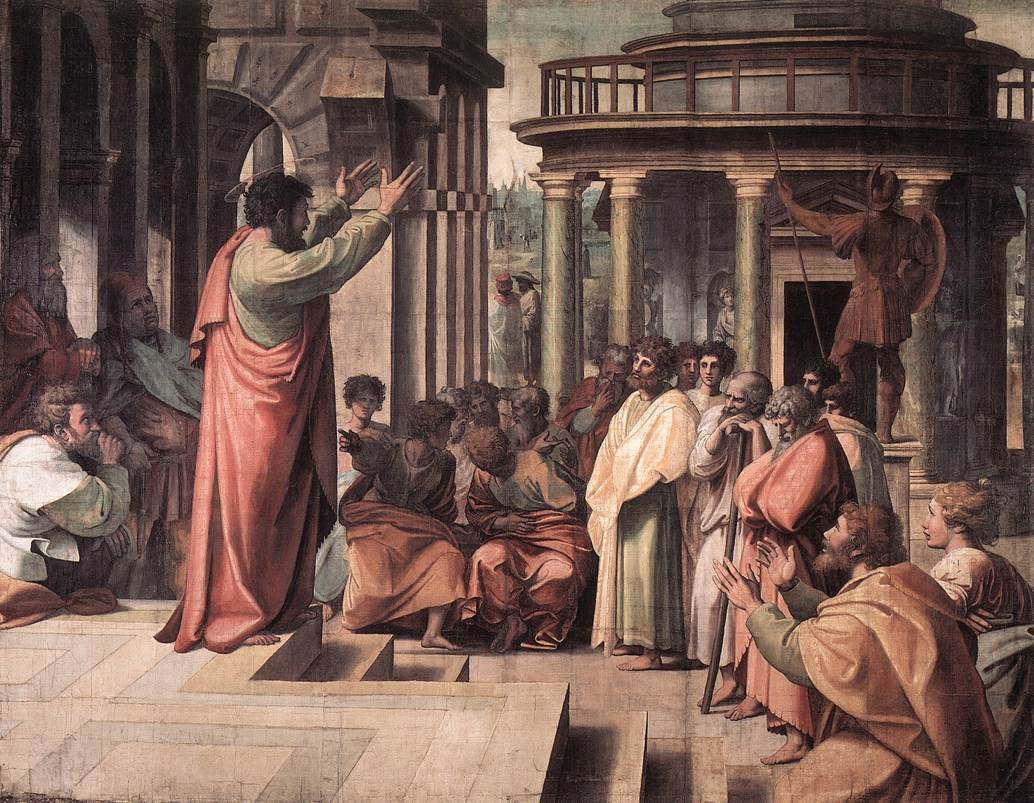
When the Apostle Paul was in Athens, he spoke to Greeks steeped in exactly this mythology. Addressing the heirs of Homer’s world, Paul confronted the culture of the Olympians face to face; however, his opening move was not to mock their gods, but to announce a God who needs nothing and gives everything:
“The God who made the world and everything in it...is not served by human hands, as though he needed anything, since he Himself gives to all mankind life and breath and everything.” (Acts 17:24-25)
The God of Scripture is categorically different from Homer’s gods: He is not the strongest being within the story, He is the Author of it. Pagan gods received gifts to be appeased; the living God of the Bible gives gifts to be known. In truth, this “unknown god” of Acts 17 turns out to be the only One who isn’t hiding anything.
After a lifetime of inspecting gifts, this may be the hardest thing for a person to believe, but love rejoices with the truth. Nolan’s The Odyssey reminds us of this.
“Always the heart within me was afraid that some man might come and deceive me with his words, since there are many who contrive for wicked advantage.”
— Penelope, The Odyssey, Book 23 (Richmond Lattimore, trans.)

I am excited to see this movie... thank you for the insight and commentary. Keep these coming!
Thank you, Craig, for your review of the movie and enlightening perspectives on its contrast and comparison to our modern deceptive traps and our God who delights to give!